

Have Your Essay on Marine Plastic Pollution from Abandoned Fishing Gear Written
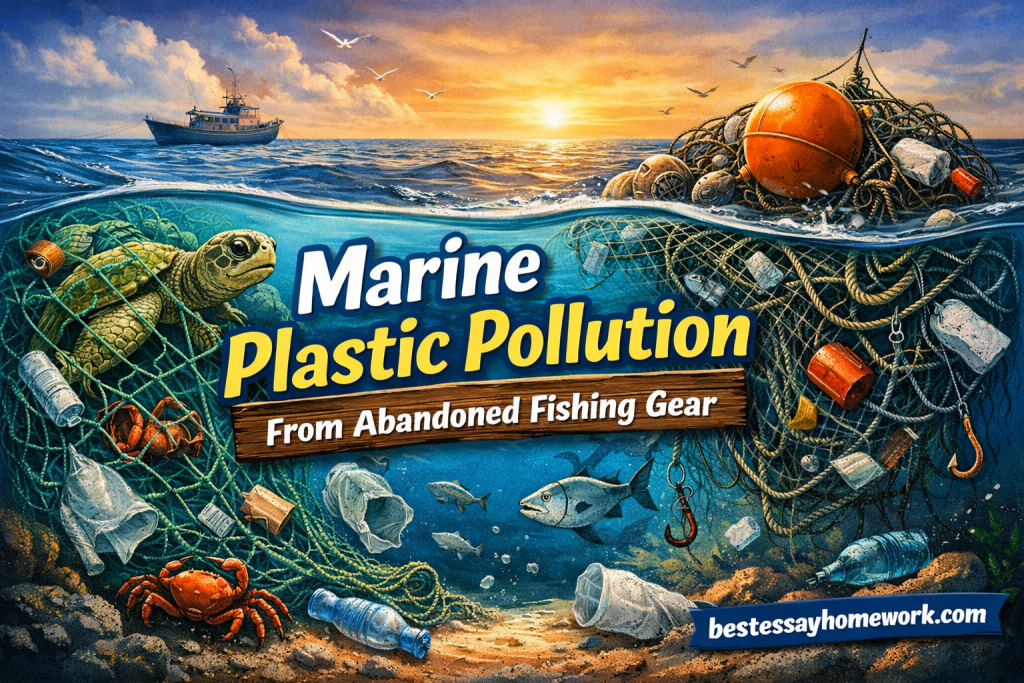
Marine plastic pollution is one of the most urgent environmental crises of our time. Among its many sources, abandoned, lost, or otherwise discarded fishing gear (ALDFG) – also known as ghost gear – constitutes a significant yet often overlooked fraction of ocean plastic. Ghost gear includes fishing nets, lines, traps, pots, and other equipment left in the ocean, which continues to entangle marine life, degrade habitats, and fragment into microplastics for centuries. If you need a well-researched, structured, and original essay on marine plastic pollution from abandoned fishing gear, you are in the right place. Our professional writers specialize in environmental science, marine biology, and policy analysis. You can order your custom essay, get assignment help, or request a report preparation. For data-heavy research, we also offer data analysis services and modeling services.
Why Abandoned Fishing Gear is a Critical Sub‑topic of Marine Plastic Pollution
Ghost gear accounts for an estimated 10% of all marine plastic debris – roughly 640,000 tons entering the oceans annually (UNEP, 2021). Unlike consumer plastics (bags, bottles), fishing gear is specifically designed to trap and hold marine animals. Even when abandoned, these nets and lines continue to “ghost fish”: entangling dolphins, whales, turtles, seabirds, and commercially valuable fish stocks. Ghost gear also damages sensitive habitats such as coral reefs and seagrass beds, leads to economic losses for fishers (lost catch, damaged vessels), and degrades into microplastics that enter the food chain. A well-written essay on this topic should address three key dimensions: environmental impact, economic consequences, and policy solutions. Below we provide a comprehensive outline, key definitions, and data points you can use.
Essay Structure – A Blueprint for a High‑Scoring Paper
1. Introduction (300–400 words)
– Hook: Start with a striking statistic: “Over 700,000 tons of ghost gear are left in our oceans each year, killing an estimated 136,000 whales, dolphins, porpoises, and seals annually.”
– Background: Marine plastic pollution overview, differentiate between land-based and ocean-based sources.
– Define ALDFG (Abandoned, Lost, or otherwise Discarded Fishing Gear).
– Thesis statement: “While consumer plastics dominate public discourse, abandoned fishing gear is equally destructive and requires targeted interventions, including gear marking, deposit schemes, and retrieval programs.”
– Roadmap of essay sections.
2. Sources and Causes of Ghost Gear (300–400 words)
– Accidental loss (storms, snagging on rocks, propeller entanglement).
– Illegal, unreported, and unregulated (IUU) fishing – intentional abandonment to avoid authorities.
– Lack of port reception facilities for end-of-life gear.
– Poor gear marking making it impossible to identify owners (and thus no responsibility).
3. Environmental Impacts (400–500 words)
– Entanglement (charismatic megafauna: sea turtles, whales, sharks).
– Ghost fishing – continued catch of fish and crustaceans, leading to stock depletion.
– Habitat destruction: broken corals, smothered seagrass, altered sediment.
– Microplastic generation: nylon and polypropylene nets fragment into secondary microplastics (5mm – 100μm), ingested by plankton, fish, and eventually humans.
– Example case: The “Great Pacific Garbage Patch” contains 46% fishing nets by weight (The Ocean Cleanup, 2018).
4. Economic Consequences (200–300 words)
– Lost revenue for fisheries: decreased fish stocks, damage to fishing vessels (entangled propellers).
– Cleanup costs: governments and NGOs spend millions on ghost gear retrieval (e.g., Global Ghost Gear Initiative).
– Tourism losses: beaches littered with nets deter visitors.
5. Solutions and Policy Interventions (400–500 words)
– Gear marking: Requiring unique identifiers on nets, traps, and lines (e.g., IMO’s voluntary guidelines).
– Deposit‑refund schemes: Fishers pay a deposit when buying gear, refunded when returning used gear to port.
– Retrieval programs: Fishing for Litter, Derelict Gear Removal Grants (e.g., NOAA’s Marine Debris Program).
– Circular economy approaches: Recycling ghost nets into new products (e.g., Econyl – regenerated nylon for clothing, carpet tiles).
– International agreements: UN Sustainable Development Goal 14.1, UNEP’s Regional Seas Programmes, the upcoming Global Plastics Treaty (expected 2025).
6. Conclusion (200–300 words)
– Restate thesis: Ghost gear is a solvable problem within the broader marine plastic crisis.
– Summarize key findings: environmental, economic, and social costs.
– Call to action: consumers (choose seafood from sustainable fisheries), policymakers (mandate gear marking), fishers (participate in retrieval programs).
– Closing thought: “Every net left in the ocean kills for decades – retrieving it saves lives, livelihoods, and the health of our blue planet.”
7. References (15–25 sources)
– Peer-reviewed articles (Science of the Total Environment, Marine Pollution Bulletin).
– Reports: FAO, UNEP, Ocean Conservancy, WWF.
– Data from The Ocean Cleanup, Global Ghost Gear Initiative (GGGI).
Key Data and Statistics to Strengthen Your Essay
- 640,000 tons – Estimated annual ghost gear entering oceans (UNEP, 2021).
- 10% – Ghost gear’s share of total marine plastic debris (by mass).
- 136,000 – whales, dolphins, porpoises, and seals killed annually by entanglement (WWF).
- 46% – Percentage of Great Pacific Garbage Patch mass composed of fishing nets (The Ocean Cleanup).
- 70% – Increase in ghost gear since 1960s, correlated with expansion of industrial fishing (Macfadyen et al., 2009).
- $1.5 billion – Annual estimated economic loss to fisheries from ghost gear (European Commission).
- 90% – Reduction in net entanglement when gear marking and retrieval programs implemented (pilot studies in Norway and Alaska).
For a custom dataset analysis, consider data analysis services to incorporate satellite tracking of ghost gear or trend analysis of entanglement reports.
Why You Should Hire a Professional to Write Your Ghost Gear Essay
- Topic‑specific expertise: Our writers have backgrounds in marine biology, environmental policy, and conservation economics. They understand terms like “ghost fishing,” “FADs (Fish Aggregating Devices),” “monofilament degradation rates,” and “pinger recall.”
- Access to paywalled sources: We use university databases (Web of Science, JSTOR, ScienceDirect) to retrieve the latest peer‑reviewed articles – some behind paywalls.
- Original data visualizations: We create custom graphs (e.g., regional ghost gear distribution, entanglement trends by species) using drawing services.
- Plagiarism‑free guarantee: Each essay is written from scratch and checked with Turnitin reports (similarity < 10%).
- Proper citation styles: We use APA 7, IEEE, Chicago, or your university’s preferred style consistently.
Common Mistakes to Avoid in Your Marine Plastic Pollution Essay
- Mistake 1 – Focusing only on microbeads and straws, neglecting ghost gear. Solution: Dedicate at least one full section to ALDFG. Use statistics to show its relative importance.
- Mistake 2 – Lacking regional case studies. Solution: Include examples from the Northeast Atlantic (Norwegian coast), Southeast Asia (Java Sea), or the Caribbean (Gulf of Honduras).
- Mistake 3 – Ignoring socio‑economic dimensions. Solution: Discuss how ghost gear affects small‑scale fishers’ livelihoods, not just charismatic animals.
- Mistake 4 – Outdated references. Solution: Use post‑2020 sources. Journal article consulting can help identify the latest meta‑analyses.
- Mistake 5 – No discussion of microplastic fragmentation. Solution: Explain that nylon nets take 400+ years to degrade, shedding microplastics that enter the food chain.
Essay Writing Process – How to Order Your Custom Paper
- Step 1 – Submit your requirements: Tell us your word count (1000–5000 words), deadline (as short as 24 hours), formatting style, and any specific questions you want answered (e.g., “Compare solutions for ghost gear in developed vs. developing nations”).
- Step 2 – Writer assignment: We match you with a writer holding a Master’s or PhD in environmental science or marine policy. You can chat with them directly.
- Step 3 – Outline approval: Within 12 hours, you receive a detailed outline (with section headings, key citations, and proposed case studies). You request changes if needed.
- Step 4 – Draft and revision: First draft delivered on time. You have up to 2 free revision rounds to adjust arguments, add data, or refine the thesis.
- Step 5 – Final delivery: You receive a polished Word/PDF file plus a plagiarism report. Optionally, we can create a presentation or summary for you.
Frequently Asked Questions (Marine Plastic Pollution Essay)
- Q1: Can you write a 3000‑word research essay on ghost gear in 48 hours?
A: Yes, we offer urgent delivery (express service) for an additional fee. We have writers available 24/7. - Q2: Do you include a thesis statement and counter‑arguments?
A: Absolutely. Every argument essay includes a debatable thesis and at least one counter‑argument (e.g., “Some fishers argue that gear marking is too expensive, but …”). - Q3: Can you incorporate my own survey data or interview transcripts?
A: Yes. Send us your raw data (Excel, CSV, interview notes). We will analyze it using data analysis services and integrate findings into the essay. - Q4: What about charts and maps?
A: Our drawing services can create maps of ghost gear hotspots (e.g., global ALDFG distribution from FAO reports) and infographics of entanglement statistics. - Q5: Is the content original? Can my professor check for plagiarism?
A: Every essay is 100% original. We provide a Turnitin report showing similarity below 10% (excluding references). No AI‑generated text is used.
Additional services we offer: thesis writing, project consulting, book writing, motivation letter writing. Take action now – save our oceans one essay at a time!
Protecting our oceans begins with ending ghost gear.
One ocean, one future—free it from plastic.
Ghost nets must vanish so marine life can flourish.
Clean seas today ensure a sustainable tomorrow.

abandoned fishing gear biodiversity loss environmental awareness fishing nets ghost gear global plastic crisis marine debris marine ecosystems marine life protection marine plastic pollution microplastics ocean conservation ocean pollution pollution solutions sustainable fishing


