

Need an Expert to Write Your Essay on Carbon Capture Technologies?
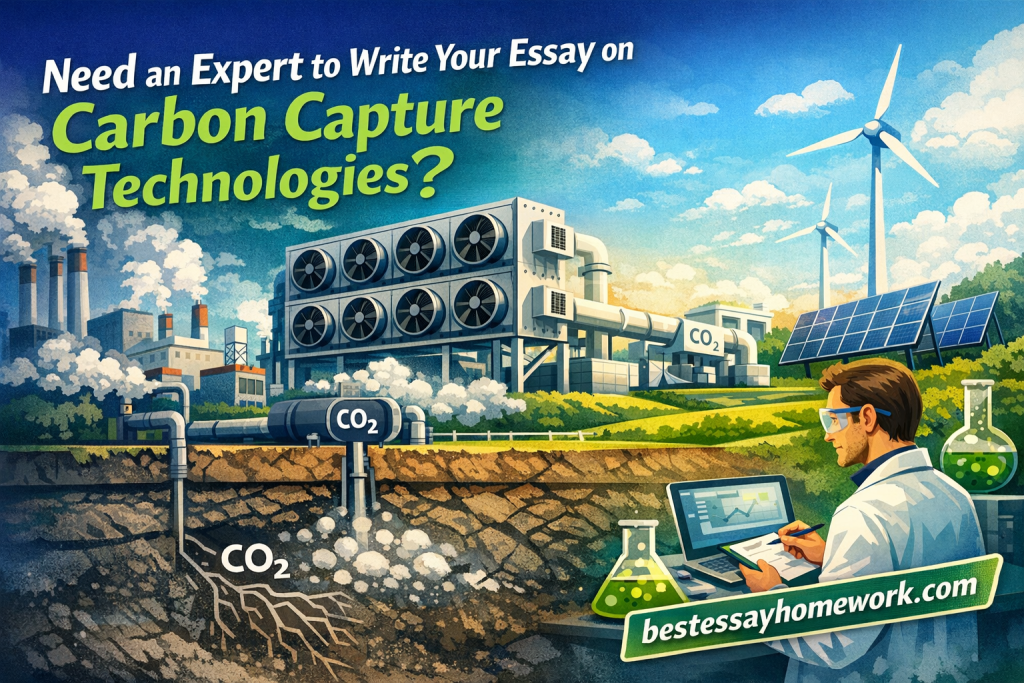
Carbon capture, utilization, and storage (CCUS) has emerged as a critical suite of technologies in the global effort to mitigate climate change, offering a pathway to decarbonize hard-to-abate industrial sectors and even remove existing carbon dioxide from the atmosphere. Writing a comprehensive essay on carbon capture technologies requires navigating a complex interdisciplinary landscape that spans chemical engineering, geology, materials science, energy policy, and environmental economics. For environmental science, engineering, and energy policy students, this assignment demands an understanding of the fundamental capture mechanisms, the challenges of transportation and storage, the economics of deployment, and the role of CCUS in broader climate mitigation scenarios. The complexity of explaining the differences between post-combustion, pre-combustion, and direct air capture, while critically evaluating their respective technical maturity, costs, and scalability, makes the decision to have your carbon capture essay crafted by a specialist in chemical engineering or climate technology a strategic investment in producing a technically accurate, conceptually sophisticated, and policy-relevant academic paper.
Capture Technologies: Three Approaches to Separating CO₂
A sophisticated essay must begin by establishing the fundamental challenge: separating dilute CO₂ from mixed gas streams. A professional writer can expertly delineate the three primary capture approaches. Post-combustion capture involves removing CO₂ from flue gas after fossil fuels have been burned, typically using chemical solvents like amines that selectively bind CO₂. This approach is retrofittable to existing power plants and industrial facilities. Pre-combustion capture involves gasifying fuel to produce synthesis gas (CO and H₂), then shifting the CO to CO₂ and H₂ through a water-gas shift reaction, capturing the CO₂ before combustion. This approach is integrated into integrated gasification combined cycle (IGCC) plants. Oxy-fuel combustion burns fuel in pure oxygen rather than air, producing a flue gas consisting primarily of CO₂ and water vapor, from which CO₂ can be easily separated by condensation. This foundational knowledge is essential for any credible engineering report or advanced research thesis in carbon management.
Absorption, Adsorption, and Membrane Separation
Within these capture approaches, multiple separation technologies exist. An expert writer can provide a detailed analysis of the dominant methods. Chemical absorption using amine solvents is the most mature technology, with decades of industrial experience in natural gas processing. They can explain the chemistry of amine-CO₂ reactions, the energy penalty of solvent regeneration (the single largest cost), and ongoing research into advanced solvents with lower energy requirements. Physical adsorption using solid sorbents like zeolites, metal-organic frameworks (MOFs), or activated carbon offers potential energy savings but faces challenges in capacity and cycling stability. Membrane separation uses selective membranes that allow CO₂ to pass more readily than other gases, offering a potentially lower-energy alternative but requiring multiple stages to achieve high purity. Understanding these technologies is crucial for any materials science project or chemical engineering journal article.
Direct Air Capture: The Frontier of Negative Emissions
While most capture targets point sources like power plants, direct air capture (DAC) aims to remove CO₂ already dispersed in the atmosphere. A skilled writer can explain the fundamental challenge: atmospheric CO₂ is approximately 400 times more dilute than flue gas, requiring enormous volumes of air to be processed and correspondingly larger energy inputs. They can describe the two main DAC approaches: liquid solvent systems (pioneered by companies like Carbon Engineering) that use alkaline hydroxide solutions to capture CO₂, and solid sorbent systems (pioneered by companies like Climeworks) that use filters coated with amine-based sorbents. They can discuss the energy requirements, costs, and land use implications of DAC, and its essential role in IPCC scenarios that limit warming to 1.5°C. This applied focus is ideal for a compelling seminar presentation and demonstrates understanding of cutting-edge climate technology.
CO₂ Transportation: Pipelines, Ships, and Safety Considerations
Once captured, CO₂ must be transported to utilization or storage sites. A comprehensive essay must address the infrastructure challenges. A writer can explain that CO₂ is typically compressed to a supercritical state (dense phase) for efficient transport. They can discuss the existing pipeline infrastructure in the United States, developed for enhanced oil recovery, and the requirements for new pipelines, including considerations of routing, materials compatibility (avoiding embrittlement), and leak detection. They can also explore alternatives like ship transport for offshore storage or regions without pipeline networks, and the safety considerations of transporting large volumes of CO₂, including the risk of asphyxiation in the event of a release. This systems-level perspective is vital for any comprehensive preparation.
Geological Storage: Permanently Containing CO₂ Underground
Storage is the final and critical step in the CCUS chain. A professional writer can elucidate the geology of CO₂ storage. They can explain that suitable storage sites require a porous reservoir rock (like saline aquifers or depleted oil and gas reservoirs) capped by an impermeable seal (like shale or salt) to prevent upward migration. They can discuss the multiple trapping mechanisms: structural trapping by the physical seal, residual trapping where CO₂ is immobilized in pore spaces, dissolution trapping where CO₂ dissolves into formation water, and mineral trapping where CO₂ reacts with rock minerals to form solid carbonates over millennia. They can also address monitoring requirements to verify containment and detect any leakage, including seismic imaging, pressure monitoring, and atmospheric monitoring. This geological understanding is essential for any geoscience-focused academic analysis.
CO₂ Utilization: Creating Value from Captured Carbon
Rather than simply storing CO₂, it can be used as a feedstock for products, creating economic value that offsets capture costs. A writer can explore various utilization pathways. Enhanced oil recovery (EOR) injects CO₂ into mature oil fields to mobilize remaining oil, generating revenue while storing CO₂—though this raises questions about net climate benefit if the recovered oil is ultimately burned. Mineral carbonation reacts CO₂ with alkaline materials (like mining wastes or certain rocks) to form stable carbonates, producing construction materials. Chemical conversion can produce fuels (via power-to-gas or power-to-liquids), chemicals, or polymers, though these processes are energy-intensive and currently expensive. They can critically evaluate the scale of potential utilization relative to the millions of tons needing storage. This balanced perspective demonstrates sophisticated understanding of the technology landscape.
Economics, Policy, and Deployment Barriers
Technical feasibility alone does not determine deployment; economics and policy are decisive. A professional writer can analyze the cost structure of CCUS, including capital costs for capture equipment, energy penalties reducing plant output, and transport and storage costs. They can explain how costs vary by CO₂ source concentration—lower for high-purity sources like ethanol plants, higher for dilute sources like power plants—and the role of learning curves in cost reduction. They can review policy mechanisms supporting deployment, including tax credits (like the US 45Q credit), carbon pricing, and government funding for demonstration projects. They can also address non-economic barriers, including public acceptance of CO₂ pipelines and storage sites, liability for long-term storage, and regulatory frameworks. This policy analysis is essential for any evidence-based report.
The Role of Data Analysis and Modeling in CCUS
Deploying CCUS at scale requires sophisticated modeling and analysis. A writer can discuss the role of data analysis in characterizing storage reservoirs, modeling CO₂ plume migration, and optimizing capture processes. They can explain how lifecycle assessment (LCA) is used to verify net emissions reductions, accounting for all energy inputs and indirect emissions. They can also address the role of integrated assessment models (IAMs) in determining the optimal mix of mitigation technologies, including CCUS, in meeting climate targets. Understanding these analytical tools is crucial for any quantitative analysis.
International Projects and Future Directions
A forward-looking essay should survey major CCUS projects worldwide. A writer can profile operational facilities like the Sleipner project in Norway (offshore storage since 1996), the Boundary Dam project in Canada (post-combustion capture on a coal plant), and the Gorgon project in Australia. They can discuss emerging hubs and clusters, where multiple industrial sources share common transport and storage infrastructure, reducing costs through economies of scale. They can also explore research frontiers, including novel sorbents and membranes, advanced process intensification, and integrating CCUS with bioenergy (BECCS) for net-negative emissions. This global perspective positions the essay at the forefront of the field.
Structuring a Coherent Technical Argument
The essay itself must reflect technical clarity and logical progression. An expert writer organizes the content with precision: an introduction framing CCUS within the climate challenge, systematic sections on capture approaches (post-combustion, pre-combustion, oxy-fuel, DAC), separation technologies, transport, storage, utilization, economics and policy, and major projects, integrated technical examples throughout, and a conclusion that synthesizes achievements and identifies priorities for research and deployment. They ensure proper citation of key studies, IPCC reports, and technical literature, and a narrative that is both rigorous and accessible. This meticulous organization provides an exemplary model for all future environmental engineering and climate policy assignments.
Achieving Technical Mastery with Expert Writing Support
Choosing to have your carbon capture technologies essay professionally written by a specialist in chemical engineering or climate technology is an investment in producing a work of exceptional technical depth and policy relevance. The result is a meticulously researched, mechanistically detailed, and globally contextualized paper that serves as a standout submission and a valuable reference for your future career in energy or environmental fields. By studying how an expert synthesizes chemical engineering principles, geological science, economic analysis, and policy considerations into a coherent and compelling narrative, you gain a deeper, more integrated understanding of this critical climate mitigation technology. This service streamlines the challenging process of mastering a vast, interdisciplinary literature spanning engineering, geology, and economics, allowing you to focus on internalizing the complexities of carbon management. For a technology essential to achieving net-zero emissions, leveraging professional support to get your paper written can be a decisive step toward both academic excellence and professional preparedness.
By mastering the concepts of carbon capture technologies, your essay will not only highlight innovative solutions but also demonstrate your ability to engage with one of the most transformative challenges of our century.

carbon capture carbon capture data analysis carbon capture essay carbon capture modeling carbon capture presentation carbon capture project carbon capture report carbon capture technologies carbon capture thesis carbon dioxide removal carbon utilization climate change solutions CO2 storage greenhouse gas reduction sustainable energy


