

Understanding the Role of Behavioral Economics in Consumer Financial Choices
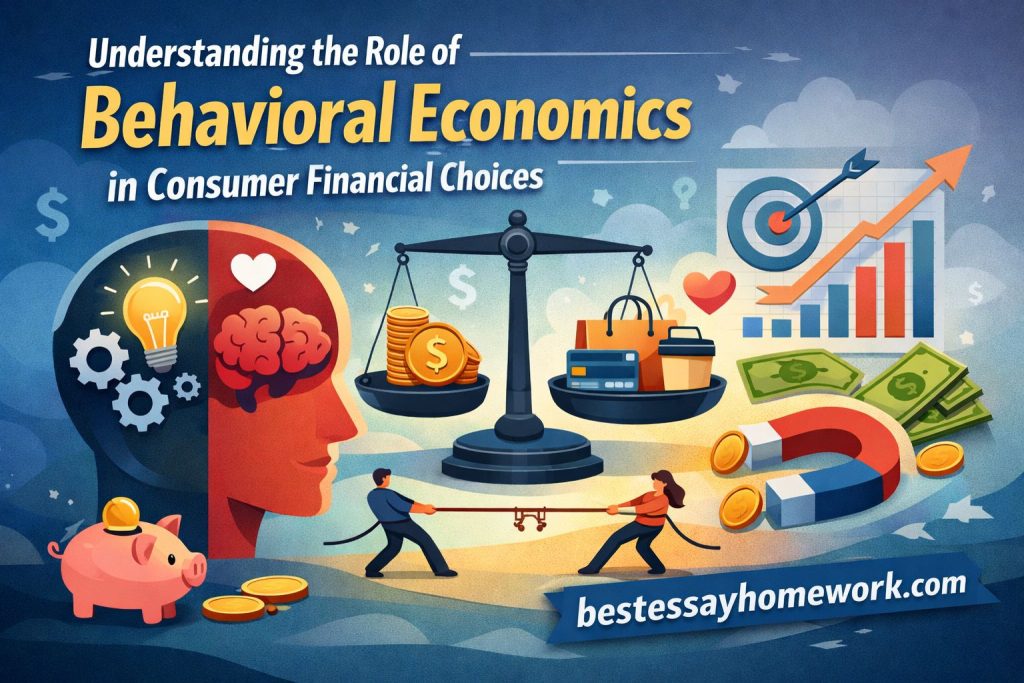
For decades, traditional economic models operated under the assumption that consumers are perfectly rational beings. This “homo economicus” was believed to make financial choices by logically evaluating all available information to maximize personal benefit. Yet, everyday experiences—from impulsive shopping sprees to the persistent difficulty of saving money—tell a different, more complex story. Behavioral economics emerges as the crucial field that bridges this gap between theoretical rationality and actual human behavior. By integrating psychological realism into economic analysis, it provides a powerful lens for understanding the true drivers behind our financial actions, from minor daily purchases to life-altering investment decisions. This understanding is vital for students, professionals, and anyone crafting an essay or analysis on contemporary finance.
The Foundational Mechanics: Heuristics and Systematic Biases
At its core, behavioral economics identifies that the human mind relies on mental shortcuts, known as heuristics, to navigate a world of overwhelming information and complex choices. While efficient, these shortcuts inevitably lead to predictable errors in judgment called cognitive biases. A prime example is the anchoring effect, where an individual relies too heavily on the first piece of information encountered (like a manufacturer’s suggested retail price) when making a subsequent decision, such as negotiating a final cost. Another powerful force is loss aversion, where the pain of losing a sum of money is psychologically far more significant than the pleasure gained from acquiring the same amount. This bias explains why people might sell winning stocks too early to “lock in gains” but hold onto losing stocks for too long, hoping to avoid realizing a loss. Documenting and analyzing these patterns forms the basis of any serious project or academic thesis in this domain.
Mental Accounting and the Illusion of Control
One of the most relatable concepts in behavioral finance is mental accounting, the tendency for people to separate their money into non-fungible categories based on subjective criteria. For instance, someone might treat a year-end bonus as “fun money” destined for a luxury purchase, while their regular salary is allocated strictly for bills and essentials, even though all funds are economically identical. This compartmentalization can lead to irrational budgeting and spending patterns. Similarly, the illusion of control leads individuals to believe they can influence outcomes that are largely determined by chance, such as picking “hot” stocks based on recent trends rather than fundamental analysis. These psychological frameworks are not just theoretical; they are actively leveraged in marketing and product design, a topic ripe for a detailed report or case study assignment.
Present Bias and the Challenge of Long-Term Planning
Perhaps the most significant hurdle in personal finance is present bias, a facet of hyperbolic discounting where people give stronger weight to payoffs that are closer to the present time. This leads to the chronic postponement of beneficial long-term actions, like contributing to a retirement fund, in favor of immediate gratification. The design of many financial products, from high-interest payday loans to buy-now-pay-later schemes, directly exploits this bias. Understanding this struggle between present and future selves is essential for anyone designing a financial literacy presentation or writing a policy brief on encouraging national savings rates. Effective interventions, known as “nudges,” are built specifically to counteract present bias, such as automatically escalating an employee’s pension contribution rate each year.
Choice Architecture: How Context Dictates Decisions
Behavioral economics teaches us that decisions are never made in a vacuum; they are profoundly shaped by the context in which they are presented—the so-called choice architecture. The way options are framed, the number of alternatives presented, and the default setting all exert enormous influence. A classic example is the dramatic increase in organ donor registration when the default option is “yes” with an opt-out choice, versus “no” with an opt-in. In consumer finance, this could mean the difference between opting into or out of a high-fee overdraft protection service. Analyzing this architecture requires careful data analysis of user behavior and is a sophisticated area of study often explored in advanced academic research and journal publications.
From Understanding to Application: Nudges and Financial Tools
The ultimate value of behavioral economics lies in its application to create tools and policies that help people make better financial decisions. “Nudges” are gentle, non-coercive interventions that steer behavior in a beneficial direction while preserving freedom of choice. A savings app that uses round-up mechanisms from everyday purchases subtly encourages saving without demanding large, painful lump sums. A retirement plan that uses salient, visual projections of future account values can make the distant future feel more concrete and worth saving for today. Developing and testing these solutions often involves creating a behavioral model and running controlled trials, a complex project that benefits from specialized academic support.
Integrating Behavioral Insights into Your Financial Analysis
For a student or professional looking to prepare a comprehensive paper on this topic, moving from theory to a structured argument is key. A robust analysis should start by deconstructing the myth of perfect rationality. The body of the work can then systematically explore key biases—anchoring, mental accounting, present bias, loss aversion—and provide concrete examples of each in consumer financial contexts, from credit card use to investment behavior. The discussion should then pivot to applied behavioral science, examining real-world nudges in fintech apps, pension schemes, and regulatory disclosures. For those incorporating statistical evidence, thorough data analysis of consumer spending patterns or savings experiment results will add significant weight. Concluding with the future implications, such as the role of AI in personalized choice architecture, can give the work a forward-looking perspective. This structured approach not only clarifies a complex subject but also provides a ready-made framework for anyone needing to have a detailed paper written on the indispensable role psychology plays in the financial marketplace.
✨ In the end, embracing behavioral economics means unlocking smarter, brighter, and more confident financial choices for the future. ✨

academic research anchoring behavioral economics consumer finance Data Analysis economic choices financial behavior financial decision making financial planning financial psychology investment behavior loss aversion mental accounting modeling nudges overconfidence bias personal finance savings behavior status quo bias


