

Have Your Architecture Essay on Post-Disaster Temporary Housing Design Written
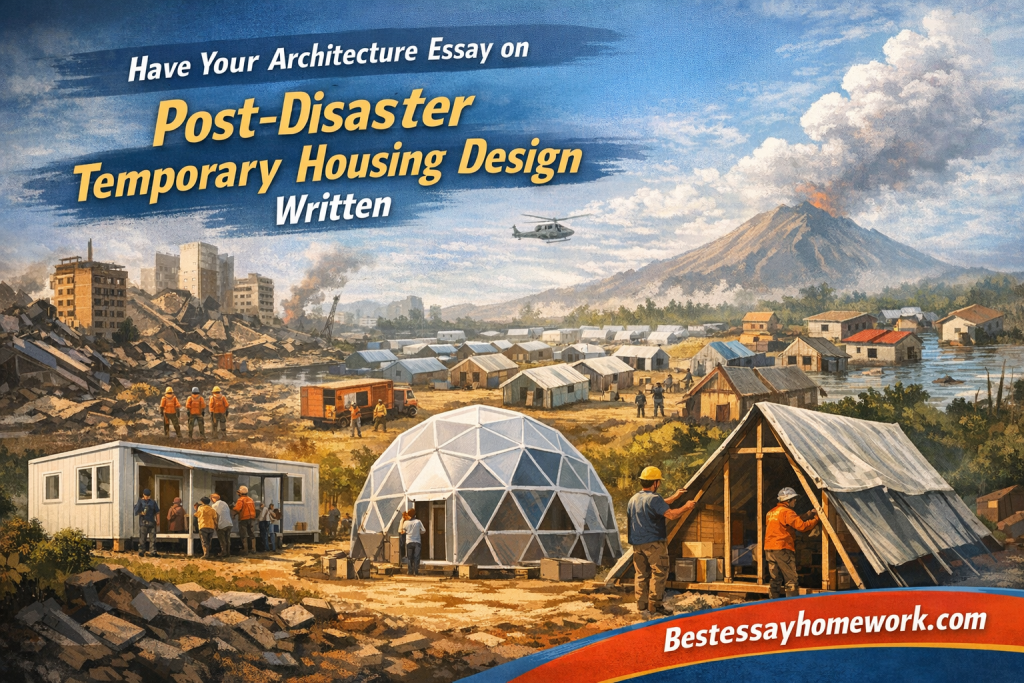
Post-disaster temporary housing represents one of the most urgent and complex challenges in contemporary architecture, requiring rapid deployment, cultural sensitivity, technical durability, and the capacity to support human dignity during periods of profound disruption. Writing a comprehensive essay on post-disaster temporary housing design requires navigating a complex interdisciplinary landscape that spans architectural design, structural engineering, humanitarian logistics, anthropology, public health, and disaster risk reduction. For architecture, urban planning, and humanitarian design students, this assignment demands an understanding of the historical evolution of temporary shelter, the technical requirements for different climatic and hazard contexts, the social and cultural dimensions of housing design, and the transition from emergency shelter to permanent reconstruction. The complexity of balancing the competing demands of speed, cost, durability, thermal comfort, cultural appropriateness, and user participation, while critically evaluating the failures and successes of past temporary housing responses, makes the decision to have your post-disaster housing essay crafted by a specialist in humanitarian architecture or disaster-resilient design a strategic investment in producing a technically sound, socially aware, and practically relevant academic paper.
Defining the Problem: Emergency Shelter vs. Temporary Housing vs. Permanent Reconstruction
A sophisticated essay must begin by distinguishing between different phases of post-disaster shelter response. A professional writer can expertly delineate the temporal and functional categories. Emergency shelter (first hours to weeks) includes tarpaulins, tents, and collective centers, prioritizing rapid deployment and protection from immediate environmental threats. Temporary housing (weeks to years) provides more durable, private accommodation for displaced populations during the reconstruction period, potentially lasting from months to several years. Transitional shelter represents an intermediate category designed to be upgraded, relocated, or incorporated into permanent housing. Permanent reconstruction aims to restore or improve pre-disaster housing conditions, ideally incorporating disaster-resilient design. They can discuss the dangers of “temporary” housing becoming semi-permanent when reconstruction is delayed, as seen in post-earthquake Haiti and post-tsunami Japan, and the psychological impact of prolonged displacement on disaster survivors. This foundational knowledge is essential for any credible humanitarian report or advanced thesis in disaster response architecture.
Historical Precedents: Lessons from Past Temporary Housing Responses
Understanding past successes and failures provides essential guidance for contemporary design. An expert writer can provide a critical historical survey. Post-World War II Europe saw rapid reconstruction using prefabricated systems and temporary barracks, some of which remained in use for decades. Post-1976 Tangshan earthquake China utilized transitional shelters that evolved into permanent housing. Post-1995 Kobe earthquake Japan deployed prefabricated temporary units that were criticized for isolation from communities and poor thermal performance. Post-2004 Indian Ocean tsunami responses included widely criticized “core houses” that were culturally inappropriate and structurally inadequate, alongside successful owner-driven reconstruction programs. Post-2010 Haiti earthquake generated numerous innovative temporary housing proposals, but most were never deployed at scale, highlighting the gap between design and implementation. Post-2015 Nepal earthquake demonstrated the value of locally appropriate transitional shelter using timber and corrugated metal. Understanding these precedents is crucial for any project on disaster-resilient design.
Technical Design Considerations: Materials, Structure, and Environment
Temporary housing must perform under challenging environmental conditions while remaining cost-effective and rapidly deployable. A skilled writer can examine the technical dimensions of design. Material selection involves trade-offs between weight, durability, thermal performance, local availability, and potential for reuse or recycling. Options include tensioned fabric structures, prefabricated modular panels, shipping containers, locally sourced timber, compressed earth blocks, and bamboo. Structural systems must resist anticipated hazards: wind loads (hurricanes, cyclones), seismic forces, snow loads, and flood risks. Thermal and environmental performance requires appropriate insulation, ventilation, shading, and moisture control to maintain habitable conditions across seasonal variations. Modularity and standardization enable efficient manufacturing and logistics but must accommodate site-specific adaptations. Relocatability and upgradability allow units to be moved to new locations or incorporated into permanent structures. This technical grounding is essential for any architectural preparation.
Cultural and Social Dimensions: Designing for Dignity and Community
Technical adequacy alone does not make successful temporary housing; cultural appropriateness and social usability are equally critical. A professional writer can explore the human dimensions of shelter design. Privacy and family structures require consideration of sleeping arrangements, separation of generations, and gendered spaces. Cultural practices influence cooking, eating, bathing, entertaining, and religious observance—activities that may not translate across cultural contexts. Community configuration affects social support networks, child supervision, and collective security; isolated individual units may undermine community resilience. User participation in design and construction can increase satisfaction, build skills, and support psychological recovery. Accessibility for elderly, disabled, and very young populations requires universal design principles. They can discuss failures where imported designs proved culturally inappropriate, such as housing lacking spaces for traditional cooking or social gatherings. This human-centered perspective is vital for any comprehensive academic analysis of humanitarian design.
Logistics, Deployment, and Supply Chain Considerations
Even the best design is useless if it cannot be deployed at scale in disaster conditions. A writer can examine the logistical realities of temporary housing distribution. Transport constraints include road conditions after disasters, port capacity, airlift availability, and the volumetric efficiency of shipping (flat-packed vs. assembled units). Storage and pre-positioning strategies stock materials in strategic locations before disasters. Supply chain vulnerabilities can be exposed when multiple disasters compete for limited manufacturing capacity and raw materials. Local manufacturing and assembly can reduce transport costs, support local economies, and ensure cultural appropriateness. Land availability and tenure present challenges: where can temporary housing be sited, and who owns the land? They can discuss the gap between design proposals and deployment realities, where many innovative designs never reach intended beneficiaries. This logistical perspective is essential for any evidence-based report.
Case Studies: Temporary Housing After Major Disasters
Empirical examination of specific responses reveals lessons for future design. A writer can analyze multiple case studies in depth. Post-2011 Great East Japan Earthquake and Tsunami saw thousands of prefabricated temporary units deployed, but survivors reported social isolation, poor thermal performance, and extended stays (up to 5+ years). Post-2005 Hurricane Katrina (US) deployed FEMA trailers that later revealed formaldehyde off-gassing health hazards, alongside successful community-led “Katrina Cottages” that offered improved design. Post-2023 Turkey-Syria earthquakes required shelter for millions in winter conditions, with container housing and tent camps facing extreme cold. Post-2017 Hurricane Maria (Puerto Rico) saw blue tarp roofs as long-term shelter, with reconstruction delayed for years. They can draw cross-cutting lessons: the importance of transition planning, the risks of prolonged temporary housing, and the value of community participation.
Transitioning to Permanent Housing: Avoiding the “Temporary Trap”
One of the greatest risks in temporary housing is becoming permanently stuck in an inadequate condition. A writer can explore strategies for successful transition. Owner-driven reconstruction provides cash or materials to affected households rather than delivering completed units, supporting local economies and culturally appropriate solutions. Core housing provides a minimal but expandable safe structure that families can complete over time as resources allow. Transitional shelter designed for upgrading includes foundations and structural systems that can support future additions. Rental assistance and housing vouchers may be more cost-effective than building temporary units in some contexts. Land tenure regularization is often the binding constraint on permanent reconstruction. They can discuss the importance of planning for transition from the outset, rather than treating temporary housing as an isolated intervention. This forward-looking perspective is essential for any policy-oriented report.
Innovations in Materials, Fabrication, and Delivery
Emerging technologies offer potential improvements in temporary housing design. A writer can survey innovative approaches. Flat-pack and rapid assembly systems using CNC-cut plywood or recycled cardboard enable rapid on-site construction. Pneumatic and inflatable structures offer extremely rapid deployment for emergency shelter. 3D-printed housing using local materials has been deployed experimentally in disaster contexts, though scalability remains limited. Upcycled shipping containers offer structural rigidity but present thermal performance challenges and are not always locally available. Locally sourced natural materials (bamboo, timber, earth) reduce transport costs and support local economies but require skilled labor. Digital design and fabrication enable site-specific customization while maintaining manufacturing efficiency. This innovation survey demonstrates awareness of emerging practice.
Structuring a Coherent Architectural Argument
The essay itself must reflect design thinking and critical analysis. An expert writer organizes the content with precision: an introduction framing post-disaster housing as both humanitarian necessity and design challenge, systematic sections on defining the problem, historical precedents, technical considerations, cultural dimensions, logistics, case studies, transition strategies, and innovations, integrated project examples throughout, and a conclusion that synthesizes findings and proposes design principles for effective, dignified, and resilient temporary housing. They ensure proper citation of humanitarian guidelines (Sphere Standards), post-disaster evaluations, and architectural precedents, and a narrative that is both rigorous and accessible. This meticulous organization provides an exemplary model for all future humanitarian architecture and disaster-resilient design assignments.
Achieving Design Depth with Expert Writing Support
Choosing to have your post-disaster temporary housing design essay professionally written by a specialist in humanitarian architecture or disaster-resilient design is an investment in producing a work of exceptional design sensitivity and practical relevance. The result is a meticulously researched, critically analyzed, and humanistically grounded paper that serves as a standout submission and a valuable reference for your future career in architecture, planning, or humanitarian response. By studying how an expert synthesizes technical performance, cultural appropriateness, logistical feasibility, and transition planning into a coherent and compelling design argument, you gain a deeper, more integrated understanding of how architecture can serve vulnerable populations in moments of crisis. This service streamlines the challenging process of mastering a field spanning design, engineering, anthropology, and humanitarian studies, allowing you to focus on internalizing the principles that will guide your professional practice. For a discipline at the intersection of design and social justice, leveraging professional support to get your paper written can be a decisive step toward both academic excellence and meaningful engagement with humanitarian challenges.
In the face of disaster, architecture becomes more than design—it becomes a beacon of resilience, hope, and renewal.

academic research architecture essay community resilience disaster recovery emergency architecture innovative housing design modular housing post-disaster housing sustainable housing temporary shelters


