

Need an Expert to Write Your Essay on Plastic Degradation by Microorganisms?
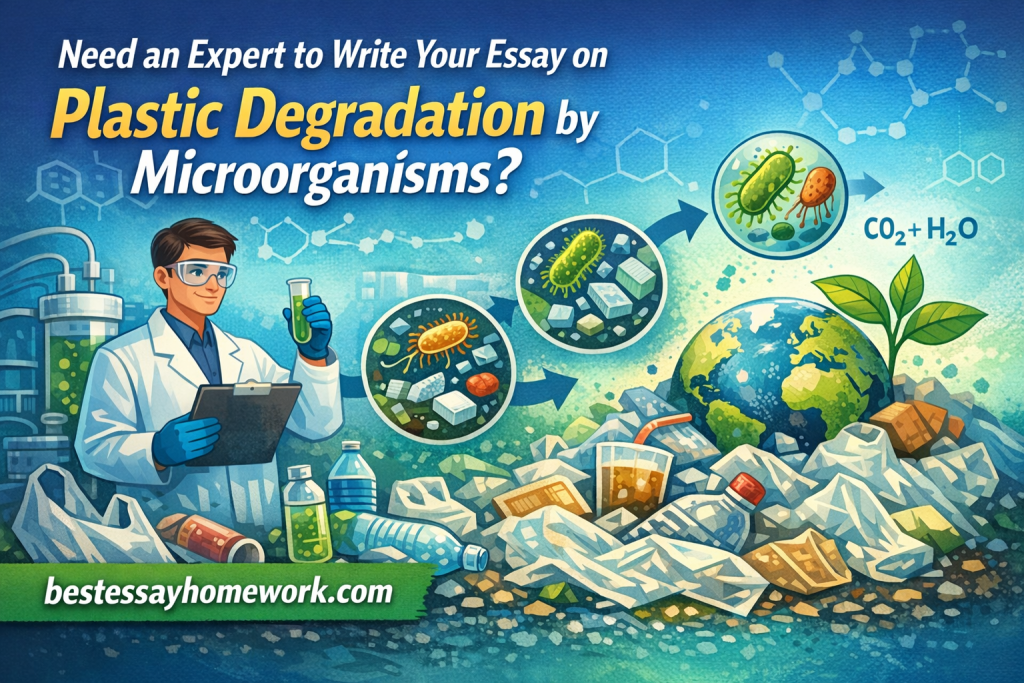
The accumulation of plastic waste in terrestrial and marine environments represents one of the most pressing environmental crises of the modern era, with millions of tons of persistent polymers entering ecosystems annually. Microbial degradation of plastics has emerged as a promising biotechnological approach to addressing this crisis, offering potential pathways to convert waste materials into harmless byproducts or valuable resources. Writing a comprehensive essay on plastic degradation by microorganisms requires navigating a complex interdisciplinary landscape that spans microbiology, biochemistry, polymer science, environmental engineering, and biotechnology. For environmental science, microbiology, and biotechnology students, this assignment demands an understanding of the chemical structures of common plastics, the enzymatic mechanisms by which microorganisms break down polymers, the environmental factors that influence degradation rates, and the practical applications of microbial degradation technologies. The complexity of explaining how specific bacterial and fungal enzymes—such as PETases, cutinases, and alkane hydroxylases—catalyze the breakdown of recalcitrant polymers like polyethylene terephthalate (PET), polyethylene (PE), and polyurethane (PUR), while critically evaluating the limitations of current degradation rates and scalability challenges, makes the decision to have your microbial plastic degradation essay crafted by a specialist in environmental microbiology or biopolymer chemistry a strategic investment in producing a technically accurate, mechanistically detailed, and application-oriented academic paper.
The Plastic Problem: Polymer Chemistry and Environmental Persistence
A sophisticated essay must begin by establishing the chemical basis for plastic persistence. A professional writer can expertly explain the structural features that make common plastics resistant to degradation. Polyethylene (PE), the most widely produced plastic, consists of long carbon-carbon backbone chains with no hydrolyzable bonds, requiring oxidation before chain cleavage. Polypropylene (PP) shares similar recalcitrance with additional methyl side chains. Polyethylene terephthalate (PET) contains ester bonds that are theoretically hydrolyzable, making it more amenable to enzymatic degradation than polyolefins. Polyurethane (PUR) contains urethane linkages susceptible to hydrolysis by specific enzymes. Polystyrene (PS) and polyvinyl chloride (PVC) present additional challenges due to their aromatic rings and chlorine content, respectively. They can discuss how additives, crystallinity, molecular weight, and surface area influence degradation rates, with amorphous regions degrading faster than crystalline domains. This foundational knowledge is essential for any credible environmental science report or advanced research thesis in plastic biodegradation.
The Microbial Degradation Process: Biofilm Formation, Secretion, and Assimilation
Microbial degradation of plastics involves a multi-stage process requiring colonization, enzyme secretion, and metabolism of breakdown products. An expert writer can provide a detailed analysis of this process. Biofilm formation on plastic surfaces represents the initial colonization stage, where microorganisms attach and produce extracellular polymeric substances (EPS) that facilitate further colonization and enzyme retention. Enzyme secretion involves the production of extracellular hydrolases, oxidases, or peroxidases that catalyze polymer breakdown. Surface erosion occurs as enzymes cleave polymer chains at or near the surface, progressively degrading the material. Assimilation of degradation products involves uptake of monomers or oligomers into microbial cells, where they enter central metabolic pathways for energy production or biomass synthesis. They can discuss how degradation rates depend on the accessibility of polymer chains to enzymes, with surface area, temperature, pH, and oxygen availability influencing activity. Understanding this process is crucial for any project on bioplastic waste treatment.
Key Microbial Enzymes for Plastic Degradation: PETases, Cutinases, and Beyond
Specific enzymes capable of hydrolyzing synthetic polymers have been identified from diverse microorganisms. A skilled writer can examine the most well-characterized enzyme systems. PETases, first discovered from Ideonella sakaiensis 201-F6, hydrolyze PET into mono(2-hydroxyethyl) terephthalic acid (MHET) and ethylene glycol, with MHET further hydrolyzed by MHETase to terephthalic acid and ethylene glycol. They can explain how structural studies of PETase have enabled protein engineering to improve thermostability and activity. Cutinases, originally identified for degradation of plant cutin, exhibit broad substrate specificity including activity on PET and other polyesters. Alkane hydroxylases and laccases catalyze initial oxidation steps for polyethylene degradation, introducing hydroxyl groups that enable further chain cleavage. Urethanases and amidases hydrolyze urethane and amide linkages in polyurethanes and polyamides. Manganese peroxidases (MnPs) and lignin peroxidases (LiPs), evolved for lignin breakdown, also oxidize recalcitrant plastic polymers. This enzymatic grounding is ideal for a compelling seminar presentation and demonstrates sophisticated biochemical knowledge.
Fungal Degradation of Plastics: A Complementary Approach
Fungi, particularly white-rot fungi, offer distinct advantages for plastic degradation through their powerful oxidative enzyme systems. A professional writer can explore fungal degradation mechanisms. White-rot fungi (Phanerochaete chrysosporium, Trametes versicolor, Pleurotus ostreatus) secrete lignin-modifying enzymes (laccases, MnPs, LiPs) that oxidize recalcitrant polymers through radical-mediated mechanisms. Ascomycete fungi (Aspergillus, Penicillium, Fusarium species) produce cutinases and other hydrolases active on polyesters. Marine fungi adapted to high-salinity environments may offer unique enzymatic capabilities. They can discuss how fungal mycelia penetrate plastic surfaces, creating physical disruption alongside enzymatic attack, and how fungal consortia may achieve more complete degradation than single species. This comparative perspective is essential for any academic analysis of biodegradation strategies.
Environmental Factors Influencing Degradation Rates
The rate and extent of microbial plastic degradation depend strongly on environmental conditions. A writer can analyze the key factors. Temperature affects enzyme activity and microbial growth, with mesophilic (20-40°C) and thermophilic (50-70°C) degradation systems operating at different optima. pH influences enzyme stability and activity, with most plastic-degrading enzymes functioning optimally near neutral pH. Oxygen availability determines whether degradation proceeds through oxidative or hydrolytic pathways, with anaerobic degradation generally slower. Nutrient availability (nitrogen, phosphorus, trace elements) limits microbial growth and enzyme production in oligotrophic environments like oceans. Plastic properties including crystallinity, molecular weight, surface area, and additive content strongly influence degradation susceptibility. Microbial community composition determines which enzymatic capabilities are present. Understanding these factors, including the role of data analysis in optimizing degradation conditions, is crucial for any applied report.
Marine Environments: The Plastisphere and Biodegradation in Oceans
Oceans receive massive plastic inputs, yet microbial degradation in marine environments remains poorly understood. A writer can explore the unique characteristics of marine plastic degradation. The plastisphere refers to the microbial communities that colonize plastic surfaces in marine environments, distinct from surrounding water communities. Cold, oligotrophic conditions in much of the ocean slow microbial metabolism and degradation rates. Biofouling and sinking transport plastics to deeper waters and sediments, where different microbial communities may degrade plastics under high pressure and low temperature. Halotolerant and halophilic enzymes adapted to high salinity may offer unique capabilities. They can discuss the paradox that while plastics accumulate in oceans, measured degradation rates are extremely slow, suggesting that marine microbes have not yet evolved efficient plastic-degrading enzymes on evolutionary timescales. This environmental perspective is vital for any comprehensive preparation.
Protein Engineering and Directed Evolution for Improved Enzymes
Natural plastic-degrading enzymes often have suboptimal activity for industrial applications, driving efforts to improve them through protein engineering. A professional writer can explore enzyme engineering approaches. Directed evolution creates libraries of enzyme variants through random mutagenesis or recombination, selecting for improved activity, thermostability, or substrate range. Rational design uses structural information to introduce targeted mutations, such as those that widen the active site or improve substrate binding. Machine learning-guided engineering predicts beneficial mutations from sequence-function relationships. They can discuss successful examples, including PETase variants with enhanced activity on crystalline PET and improved thermostability for industrial processing. They can also address the challenge of balancing activity with stability and the need for high-throughput screening methods. This biotechnological perspective demonstrates understanding of applied microbiology.
From Laboratory to Application: Bioreactors, Composting, and Enzymatic Recycling
Translating laboratory discoveries into practical waste treatment requires appropriate engineering systems. A writer can survey application pathways. Enzymatic recycling uses purified or immobilized enzymes to depolymerize plastics into monomers for repolymerization, enabling closed-loop recycling. Companies like Carbios have demonstrated enzymatic PET recycling at pilot scale. Bioreactor systems for plastic degradation optimize temperature, pH, aeration, and mixing to maximize degradation rates. Composting with microbial consortia may degrade biodegradable plastics under controlled conditions, though most conventional plastics do not degrade in composting systems. Landfill bioaugmentation adding plastic-degrading microbes to landfills remains experimental. Marine bioremediation faces immense scaling challenges given the dilution and dispersion of ocean plastics. They can discuss the economic viability of enzymatic recycling compared to mechanical recycling and incineration. This application focus is essential for any policy-oriented report.
Case Studies: Discovery and Development of PET Degradation
The discovery of Ideonella sakaiensis and its PET degradation pathway provides a compelling case study of how microbial plastic degradation research advances. A writer can examine this paradigmatic example. Ideonella sakaiensis was isolated from sediment near a PET bottle recycling facility in Japan, where it had apparently evolved to use PET as a carbon source. The genome revealed two key enzymes: PETase (a cutinase-like serine hydrolase) and MHETase (a MHET hydrolase). Structural studies of PETase revealed that, unlike cutinases, PETase has a more open active site accommodating the PET polymer. Subsequent protein engineering produced improved variants, including the widely studied “FAST-PETase” and “HotPETase” with enhanced activity and thermostability. This discovery has inspired global research efforts to identify and engineer other plastic-degrading enzymes. This case study demonstrates how basic microbiology can lead to practical applications.
Limitations and Challenges: Rate, Scale, and Complexity
Despite progress, significant limitations remain for microbial plastic degradation. A professional writer can critically evaluate current challenges. Degradation rates remain too slow for industrial application, with most enzymes requiring days to weeks for significant polymer breakdown. Crystalline regions resist enzymatic attack, leaving undegraded residues. Mixed plastic waste contains diverse polymers requiring different enzyme systems. Additives and contaminants may inhibit enzymes or release toxic byproducts. Energy and resource inputs for enzyme production and bioreactor operation may offset environmental benefits. Scale-up challenges from laboratory to pilot scale introduce mixing, mass transfer, and contamination issues. They can discuss the need for realistic assessment of where microbial degradation can make meaningful contributions to plastic waste management, recognizing that reduction, reuse, and mechanical recycling remain higher priorities. This critical perspective demonstrates sophisticated scientific literacy.
Structuring a Coherent Scientific Argument
The essay itself must reflect scientific clarity and logical progression. An expert writer organizes the content with precision: an introduction framing the plastic pollution crisis, systematic sections on polymer chemistry, microbial degradation mechanisms, key enzymes (PETases, cutinases, fungal systems), environmental factors, marine degradation, protein engineering, applications, case studies, and limitations, integrated molecular examples throughout, and a conclusion that synthesizes achievements and identifies priorities for research and development. They ensure proper citation of key discovery papers, biochemical studies, engineering reports, and review articles, and a narrative that is both rigorous and accessible. This meticulous organization provides an exemplary model for all future environmental microbiology and biotechnology assignments.
Achieving Scientific Depth with Expert Writing Support
Choosing to have your essay on plastic degradation by microorganisms professionally written by a specialist in environmental microbiology or biopolymer chemistry is an investment in producing a work of exceptional scientific depth and biotechnological relevance. The result is a meticulously researched, mechanistically detailed, and critically evaluated paper that serves as a standout submission and a valuable reference for your future career in environmental science or biotechnology. By studying how an expert synthesizes polymer chemistry, enzymology, microbiology, and engineering into a coherent and compelling narrative, you gain a deeper, more integrated understanding of nature’s potential to address the plastic crisis. This service streamlines the challenging process of mastering a field spanning chemistry, biology, and environmental engineering, allowing you to focus on internalizing the principles that will guide your scientific practice. For a discipline at the frontier of environmental solutions, leveraging professional support to get your paper written can be a decisive step toward both academic excellence and meaningful engagement with global environmental challenges.
Together, by unlocking the hidden power of microorganisms, we can transform plastic waste into a cleaner tomorrow!

academic research bacteria biodegradation bioreactors biotechnology Data Analysis environmental restoration fungi journal articles microbial ecology microbial enzymes microorganisms PETase plastic degradation plastic pollution plastic recycling pollution solutions project development recycling sustainability synthetic biology waste management


