

Get Your Environmental Essay on Wildland-Urban Interface Fire Risk Zoning Written
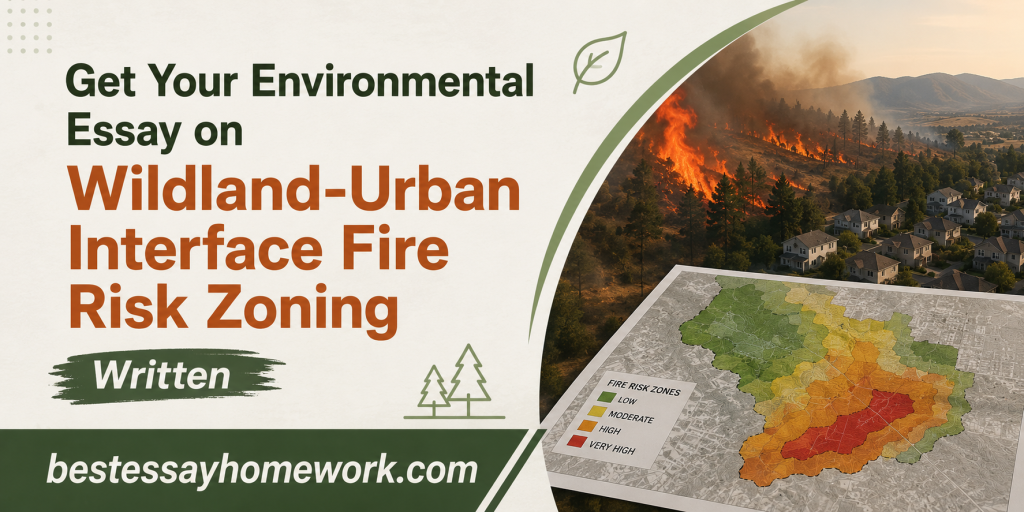
The Wildland-Urban Interface (WUI) has become a focal point of environmental research, urban planning, and disaster management, particularly as climate change intensifies wildfire seasons across the globe. WUI fire risk zoning refers to the systematic classification and mapping of areas where human settlements overlap with wildland vegetation, based on their susceptibility to fire hazards. This subject demands a multidisciplinary approach, combining fire ecology, geospatial analysis, land-use policy, and risk communication. Writing a comprehensive and academically sound essay on this topic requires not only extensive research but also the ability to present complex data in a clear, structured, and persuasive manner. This article explores the critical aspects of WUI fire risk zoning and explains how expert writing services can help you produce a high-impact environmental essay tailored to your academic or professional needs.
Understanding WUI Fire Risk Zoning: Concepts and Importance
Wildland-Urban Interface areas are dynamic zones where natural vegetation and human infrastructure coexist. These regions are particularly susceptible to catastrophic wildfires due to the abundance of combustible materials, topographic features, and weather patterns that accelerate fire spread. Fire risk zoning in WUI areas involves the use of scientific criteria to categorize land into zones of varying risk levels, facilitating better land-use planning, building code enforcement, evacuation route mapping, and resource allocation for fire suppression.
The zoning process typically relies on detailed spatial data, including vegetation types, slope angles, elevation, historical fire occurrences, and proximity to roads and water sources. Advanced Data Analysis and geographic information systems (GIS) are used to generate hazard maps that identify high-risk zones where fire mitigation measures such as fuel breaks, defensible space regulations, and early warning systems are most needed. These maps are essential tools for policymakers, fire departments, and urban planners aiming to reduce fire-related losses and enhance community resilience.
Key Components of a Strong Environmental Essay on WUI Fire Risk Zoning
An exceptional essay on WUI fire risk zoning should be well-researched, logically structured, and analytically rigorous. The following components are essential for a comprehensive and impactful paper:
- Introduction: Clearly define the WUI concept and explain why fire risk zoning is critical in the context of climate change and urban expansion. Use recent wildfire statistics to establish the significance of the issue.
- Theoretical and Scientific Background: Review existing literature on fire behavior, fire ecology, and risk assessment methodologies. Reference studies that analyze the effectiveness of various zoning approaches.
- Methodological Framework: Describe the data sources, technologies, and analytical tools used in fire risk zoning, including satellite remote sensing, GIS-based Modeling, and machine learning algorithms for fire prediction.
- Case Studies: Examine successful WUI fire risk zoning implementations in different regions, such as California, Australia, or southern Europe. Compare their strategies, regulatory frameworks, and outcomes.
- Challenges and Limitations: Address the technical, financial, and social obstacles to effective zoning, such as data gaps, climate uncertainties, landowner resistance, and outdated infrastructure.
- Policy Recommendations: Propose evidence-based strategies for improving zoning systems, including the integration of real-time climate data, community engagement, and incentive programs for fire-resistant construction.
- Conclusion: Summarize the key insights, reiterate the urgency of proactive zoning, and call for stronger interdisciplinary collaboration between scientists, planners, and local communities.
How Professional Writing Services Can Elevate Your Essay
Writing a high-quality environmental essay on a technically demanding subject like WUI fire risk zoning can be overwhelming, especially for students and early-career professionals. Time constraints, language barriers, and the complexity of the subject matter often compromise the depth and clarity of the final output. Professional Project and essay writing services offer a practical solution by providing access to subject-matter experts who are experienced in environmental science, policy analysis, and academic writing.
Here are some key advantages of using professional writing support:
- Expert Research: Writers with backgrounds in environmental studies, geography, and engineering can locate the most relevant and up-to-date sources, including government Reports, scientific articles, and institutional guidelines.
- Original Content: All essays are written from scratch and can be verified with Turnitin to guarantee originality and adherence to academic integrity standards.
- Professional Formatting: Essays are formatted in accordance with your required citation style (APA, MLA, Chicago, or Harvard), ensuring compliance with institutional guidelines.
- Clarity and Precision: Native-level English writers ensure your essay is grammatically correct, stylistically consistent, and technically accurate.
- Visual Support: If your essay requires maps, diagrams, or illustrations, professional services can also provide Drawing and graphic design support to enhance the visual appeal and explanatory power of your work.
Additionally, experts can help you prepare a concise and compelling Summary (abstract) or executive summary if required. This is particularly useful for submissions to academic journals or conference Presentations where brevity and impact are crucial.
Why WUI Fire Risk Zoning Matters in Environmental Studies
Wildland-Urban Interface fire risk zoning is not merely an academic topic—it is a pressing public safety and environmental justice issue. With increasing wildfire intensity and frequency driven by climate change, communities in fire-prone areas are more vulnerable than ever. Zoning policies directly influence how land is developed, how infrastructure is planned, and how emergency services prepare for disasters. Therefore, essays on this subject contribute to broader debates on sustainable development, climate adaptation, and equitable risk reduction.
Moreover, the interdisciplinary nature of WUI fire risk zoning allows students to integrate knowledge from environmental science, urban planning, public policy, and engineering. This makes it an ideal topic for capstone Thesis projects, research papers, and policy briefs. A well-crafted essay demonstrates your ability to synthesize information, think critically, and propose actionable solutions to real-world problems.
Final Thoughts
Writing an environmental essay on Wildland-Urban Interface fire risk zoning requires a solid understanding of scientific principles, spatial analysis techniques, and policy frameworks. It also demands clear, persuasive, and well-organized writing. If you are struggling with any aspect of this process—whether it’s research, structuring, or language—professional academic writing and consulting services can provide the support you need. From Preparation to final Printing and submission, expert teams are available to guide you through every stage. Don’t let the complexity of the subject hold you back; invest in a professionally written essay and make a meaningful contribution to environmental safety and urban resilience.
🌟 With strong fire risk zoning strategies, communities in the Wildland-Urban Interface can build safer, smarter, and more sustainable futures. 🌟

academic research climate adaptation climate change impact Community Preparedness Data Analysis Fire Risk Zoning Fire-Resistant Construction journal articles modeling project planning Sustainable Planning urban sustainability Vegetation Management Wildfire Mitigation Wildland-Urban Interface


